
如果我说,你今天晚交作业,明天整个教育体系就会崩溃,你会相信吗?
If I told you that turning in your homework late today would collapse the entire education system tomorrow, would you believe me?
It begins, as many disasters supposedly do, with something small.
就像许多所谓的灾难一样,一切都始于一件小事。
A city council gathers to discuss a modest environmental proposal: protecting a stretch of wetlands along the river. No factories, no housing developments, just reeds, birds, and muddy water allowed undisturbed.
市议会开会讨论一项温和的环保提案:保护河边的一片湿地。不许建工厂,不许搞房地产开发,只允许芦苇、鸟类和泥水安然无恙。
One council member raises a hand.
一位议员举起了手。
"We protect wetlands today," he says gravely, "and tomorrow developers won't be allowed to build anywhere. If property rights weaken, investors leave. When investment dries up, the economy collapses. And once the economy collapses, families will have no jobs and no homes."
"我们今天保护湿地,"他严肃地说,"明天开发商就哪儿都不准建房子了。如果产权被削弱,投资者就会离开。投资枯竭了,经济就会崩溃。而一旦经济崩溃,家家户户就会失去工作和家园。"
The room falls silent. The argument sounds frighteningly plausible. After all, history is full of unintended consequences.
会议室里一片寂静。这个论点听起来可怕地合理。毕竟,历史上充满了意想不到的后果。
But something about the logic feels … slippery.
但这逻辑总觉得……有点滑。
Did one conservation rule really begin an unstoppable march toward economic ruin?
一项保护规则,真的会开启一场通往经济崩溃的不可阻挡的进程吗?
Or did the argument simply slide down a slippery slope?
还是说,这个论点只是在滑坡上滑了一跤?
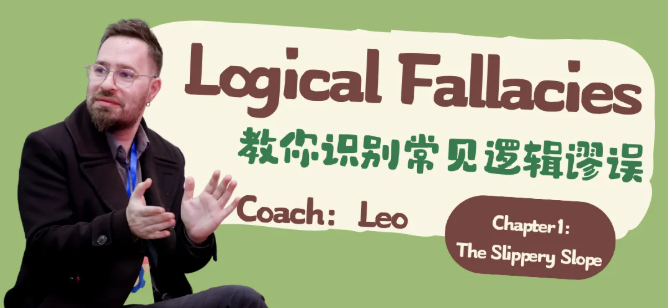
Welcome to the first article in our series on logical fallacies that quietly sabotage arguments in debate rounds. If you learn to recognize them, you won't just become a stronger debater. You'll become harder to fool.
欢迎来到我们的逻辑谬误系列第一篇文章——这些谬误常常在辩论中悄然破坏论证。如果你学会识别它们,你不仅会成为更强大的辩手,还会变得更难被欺骗。
The slippery slope fallacy is one of the most seductive moves in argumentation.
滑坡谬误是论证中最具诱惑力的手法之一。
It claims that a small initial step will inevitably trigger a chain of escalating consequences, until we arrive at some extreme, disastrous outcome.
它声称,一个小小的初始步骤将不可避免地引发一连串不断升级的后果,直到我们抵达某个极端、灾难性的结局。
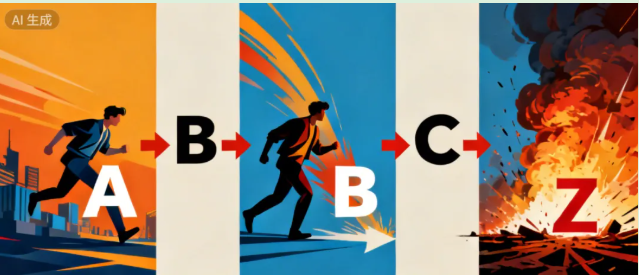
The pattern usually looks like this:
这个模式通常是这样:
A happens → which leads to B → which leads to C → which inevitably produces catastrophe Z.
A发生 → 导致B → 导致C → 最终不可避免地产生灾难Z。
Now, to be fair, consequences do matter. Policies do create ripple effects. Good debaters absolutely analyze those ripple effects.
不过公平地说,后果确实重要。政策确实会产生连锁反应。优秀的辩手绝对会分析这些连锁反应。
But the slippery slope cheats a little. It quietly skips over the hard work of proving each step. The chain is assumed rather than demonstrated. And in Public Forum debate, where teams must compress massive ideas into four-minute speeches, the temptation is irresistible. Why argue about modest risks when you can warn about the end of civilization?
但滑坡谬误会耍点小花招。它悄悄地跳过了证明每一步的艰苦工作。这个链条是被假设的,而不是被论证的。而在公共论坛辩论中,队伍必须将庞大的观点压缩进四分钟发言里,这种诱惑是不可抗拒的。当你可以警告文明终结时,为什么要去争论温和的风险呢?
But the good debaters and judges know that a dramatic prediction is only as strong as the weakest link in its chain.
但优秀的辩手和评委知道,一个戏剧性的预测,其说服力只等于链条中最薄弱的那一环。
Let's see how this appears in debates about the global dominance of English.
让我们看看这在关于英语全球主导地位的辩论中是如何出现的。
Imagine a round debating the resolution:
想象一场围绕这个辩题的辩论:
"The worldwide dominance of English is more beneficial than harmful to global cultural development."
"英语在全球的主导地位对全球文化发展利大于弊。"
The CON team rises confidently.
反方队伍自信地起身。
"English dominance begins in schools," the speaker explains. "Governments encourage English education because it improves economic opportunity. Parents begin prioritizing English fluency over their native languages. Eventually children grow up speaking only English. Once languages disappear, the traditions and histories embedded within them disappear as well. If English spreads unchecked, the world's linguistic diversity collapses and with it, global cultural richness."
"英语主导地位始于学校,"辩手解释道。"政府鼓励英语教育,因为它能增加经济机会。家长们开始优先考虑英语流利度,而不是母语。最终,孩子们长大只会说英语。一旦语言消失,其中蕴含的传统和历史也随之消失。如果英语不受限制地传播,世界的语言多样性就会崩溃,全球文化的丰富性也会随之消亡。"
It's a persuasive story.
这是一个有说服力的故事。
But examine the chain carefully.
但仔细审视这个链条。
English in schools → parents abandon native languages → children stop learning them → languages die → cultures vanish → global monoculture.
学校教英语 → 家长放弃母语 → 孩子不再学习母语 → 语言消亡 → 文化消失 → 全球单一文化。
The argument moves quickly, perhaps too quickly. Each step assumes the next one must follow.
这个论证推进得很快,也许太快了。每一步都假设下一步必然会发生。
Yet history suggests something more complicated. In many countries, English spreads alongside local languages rather than replacing them. Students become bilingual. Communities preserve traditions while still participating in global communication.
然而历史显示的情况更为复杂。在许多国家,英语与当地语言并行传播,而不是取而代之。学生变成了双语者。社区在参与全球交流的同时,仍然保留着传统。
The argument imagines a neat row of dominoes.Real cultures, however, rarely fall that neatly.
这个论证想象了一排整齐的多米诺骨牌。然而,真实的文化很少会倒得那么整齐。
Another variation appears in discussions about media and entertainment.
另一个变体出现在关于媒体和娱乐的讨论中。
"If English dominates global media," a debater argues, "English-language films and television will flood international markets. Local filmmakers won't be able to compete with Hollywood budgets. Audiences gradually abandon local storytelling. Eventually every country consumes the same English-language culture, and the diversity of world cinema disappears."
"如果英语主导了全球媒体,"一位辩手论证道,"英语电影和电视将充斥国际市场。本土电影人无法与好莱坞的预算竞争。观众逐渐放弃本土叙事。最终每个国家都消费同样的英语文化,世界电影的多样性消失了。"
Again, the narrative feels persuasive because it appeals to something real: people do worry about cultural homogenization.
同样,这种叙事感觉有说服力,因为它触及了真实存在的担忧:人们确实担心文化同质化。
But the logic leaps forward without proving the path.
但这种逻辑在没有证明路径的情况下就向前跳跃了。
Does the spread of English media actually erase local media?
英语媒体的传播真的会消灭本土媒体吗?
Consider recent reality: Korean dramas, Spanish-language shows, Indian cinema, and Turkish series have gained massive global audiences, often using English subtitles to reach viewers in dozens of countries.
看看最近的现实:韩剧、西语节目、印度电影和土耳其剧集已经获得了庞大的全球观众,它们常常借助英文字幕触达数十个国家的观众。
Ironically, English sometimes helps spread local stories internationally.
讽刺的是,英语有时反而帮助本土故事在国际上传播。
The slippery slope assumes cultural influence behaves like gravity: once one force appears, everything else must collapse downward.
滑坡谬误假设文化影响力像重力一样:一旦一种力量出现,其他一切都必须向下坍缩。
But culture is not gravity. It is negotiation, imitation, resistance, reinvention.Sometimes the global language amplifies voices rather than silencing them.
但文化不是重力。它是协商、模仿、抵抗、重塑。有时,全球性语言会放大声音,而不是让它们沉默。
Slippery slopes don't live only in debate rounds or international policy arguments. They appear in everyday conversations with surprising frequency.
滑坡谬误不仅存在于辩论赛场或国际政策争论中。它们出现在日常对话中的频率惊人。
A student approaches a teacher after class.
一个学生课后找到老师。
"Could I submit my assignment tomorrow instead of today?"
"我能明天交作业吗?"
The teacher hesitates.
老师犹豫了。
"If I give you an extra day," the teacher replies, "then everyone will expect extensions. Once deadlines stop mattering, students stop doing their work. If students stop working, standards collapse. And if standards collapse, nobody learns anything."
"如果我多给你一天时间,"老师回答,"那每个人都会期望延期。一旦截止日期不再重要,学生就不做作业了。如果学生不做作业,标准就崩溃了。如果标准崩溃了,那谁也学不到东西。"
A single late homework assignment suddenly threatens the future of education itself.
一份迟交的作业突然间威胁到了教育的未来。
Now, the teacher might have legitimate concerns about fairness and discipline.
当然,老师可能有关于公平和纪律的合理考量。
But the argument leaps from one accommodation to systemic collapse without stopping to explain why every step must follow the last.
但这个论证从一次通融直接跳到了系统崩溃,而没有停下来解释为什么每一步都必须紧随上一步。
This is the hallmark of the slippery slope: a modest decision projected into an imagined future catastrophe.
这就是滑坡谬误的特征:将一个温和的决定投射到想象出来的未来灾难中。

Great debaters treat arguments like engineers examining a bridge. If one beam cannot hold weight, the entire structure fails.
优秀的辩手对待论证就像工程师检查桥梁一样。如果一根梁无法承重,整个结构就会失败。
Here are three practical ways to dismantle a slippery slope in a round.
以下是在比赛中拆解滑坡谬误的三种实用方法。
1. Identify the Weakest Link 找出最薄弱的环节
Find the step where the argument makes its biggest leap.
找到论证中跳跃最大的那一步。
"Even if English becomes common in education, that doesn't prove languages disappear."
"即使英语在教育中变得普遍,也不能证明语言会消失。"
Once one link breaks, the dramatic ending loses its foundation.
一旦一个环节断裂,戏剧性的结局就失去了基础。
2. Demand the Mechanism 追问机制
In crossfire, ask precise questions:
在交叉质询中,提出精确的问题:
• What evidence proves step B follows step A?
• 有什么证据证明B步必然跟随A步?
• Why can't societies maintain bilingualism?
• 为什么社会不能保持双语?
• Are there examples where this predicted chain did not occur?
• 有没有例子显示这个预测的链条没有发生?
If the mechanism is missing, the slope is speculation.
如果机制缺失,滑坡就是猜测。
3. Show Where the Slide Stops 指出滑坡在哪里停止
Many systems have built-in safeguards.
许多系统都有内置的保障措施。
Language preservation programs, cultural institutions, local media industries, translation technologies, and national education policies all interrupt the supposed chain of inevitability.
语言保护项目、文化机构、本土媒体产业、翻译技术和国家教育政策,都会打断所谓的必然性链条。
Once you introduce those stopping points, the slope becomes far less slippery.
一旦你引入这些停止点,滑坡就没那么滑了。
If the reasoning is weak, why does this argument work so often?
如果推理如此薄弱,为什么这个论证还如此有效?
Because it speaks directly to our imagination.
因为它直接诉诸我们的想象力。
Humans are wired to think in stories. A chain of consequences feels like a narrative arc: a small mistake leads to tragedy.
人类天生习惯于故事性思维。一连串的后果就像一条叙事弧:一个小错误导致了悲剧。
The slippery slope weaponizes that instinct. It takes a manageable decision and stretches it into an epic cautionary tale.
滑坡谬误将这种本能武器化了。它把一个可以管理的决定,拉伸成了一个史诗般的警示故事。
In debate, where time is short and stakes feel high, epic stories can be very persuasive.
在辩论中,时间短暂,利害关系似乎很高,史诗故事可以非常具有说服力。
But good reasoning requires something quieter and harder: proof that each step in the story actually holds.
但好的推理需要一些更安静、更难的东西:证明故事中的每一步实际上都站得住脚。
Drama captures attention.But logic earns the ballot.
戏剧性吸引注意力。但逻辑赢得选票。
A CON speaker in the same English-dominance debate says:
同一场英语主导地位辩论中的反方辩手说:
"PRO claims English simply helps people communicate globally. But what they really support is replacing local languages everywhere, schools, media, even everyday conversation. If English becomes dominant, people will be forced to abandon their mother tongues and thousands of cultures will disappear."
"正方声称英语只是帮助人们全球沟通。但他们真正支持的,是在所有地方——学校、媒体、甚至日常对话——取代当地语言。如果英语变得主导,人们将被迫放弃母语,成千上万的文化将会消失。"
What logical fallacy appears in this argument?
这个论证中出现了什么逻辑谬误?
And how would you refute it in a debate round?
你会如何在辩论中反驳它?
Think carefully. The answer will appear in the next article.
仔细想想。答案将在下一篇文章中揭晓。